CoinDrop gives everyone in a Discord server, Telegram group or Kick chat a crypto wallet they can use without leaving the conversation. You can tip someone with @CoinDrop tip @user 1 sol, put a $5 pot on the table with @CoinDrop airdrop $5 sol 60s, and withdraw to any of 26 chains when you're done.
I started it in September 2025 as a small tipping bot in my own Discord server. A year and about 570 commits later, 6,500+ people in 500+ communities use it, it has moved more than $2M on-chain, and it handles 2,000–3,000 withdrawals a day. I'm the founder and lead developer: I wrote the bot, the wallet and the site, and I've answered more than 700 support tickets myself.
How it grew
- 200 users, all from CoinDrop's own Discord, before it was listed anywhere. Six EVM chains, live USD prices, and the 0.5% fee model already in place.
- 1,000 users after Solana, Banano and Base support landed, and the first 15 servers had added it on their own.
- Months stuck at 100 servers while Discord reviewed its privileged intents. Once approved, it grew past 400 servers.
- Telegram, built in one day at Build IRL 2 by Dodo Payments. CoinDrop won the event.
- Kick chat and a web wallet at wallet.coindrop.cc, on the same account and balance as before.
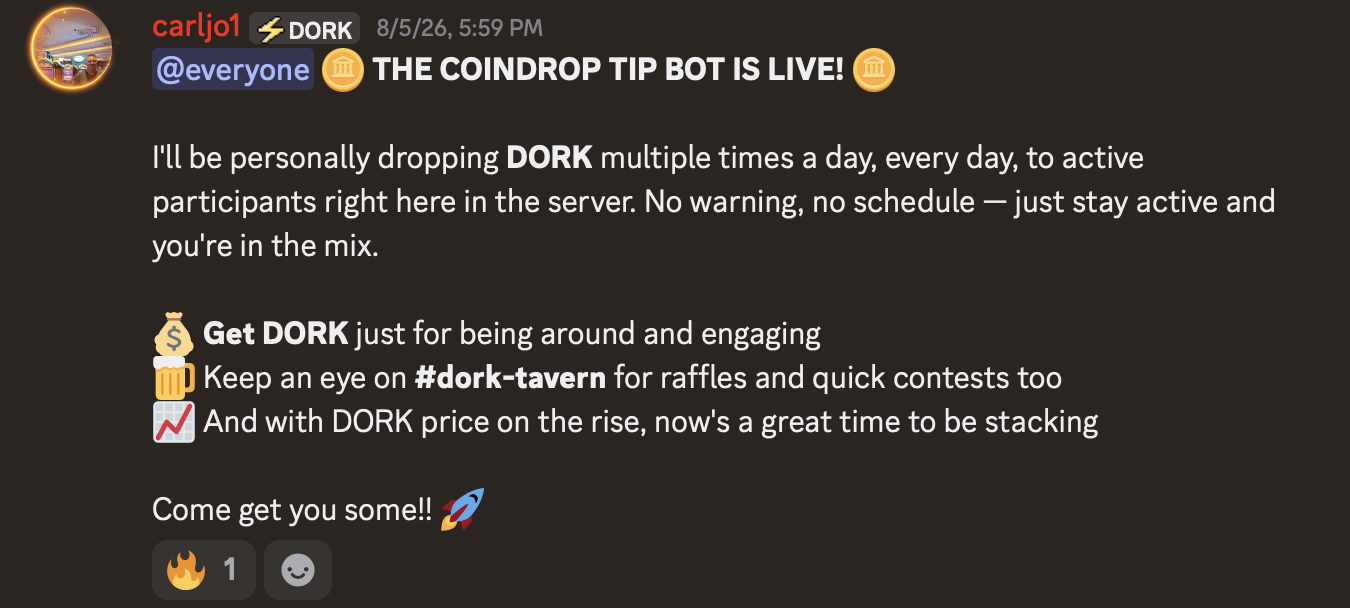
Dorkcoin announcing CoinDrop to their community. They now run drops through it multiple times a day.
How it works
CoinDrop is custodial. Real coins live in on-chain wallets, and each user's balance lives in a MySQL ledger. That split is the whole design: deposits and withdrawals touch the chain, and everything in between is a database transaction.
- Deposit.
/deposit solcreates or reuses a per-user address and DMs it. A poller per chain watches for funds, sweeps them into a hot wallet, and credits the ledger minus a 0.5% fee. - Tip and drop. Tips and drop games are row-locked updates, so they're instant and cost no gas. Amounts are stored as integers in each coin's smallest unit (
DECIMAL(65,0)), so there's no float rounding anywhere. - Withdraw.
/withdrawonly works in DMs. It quotes platform fee and live gas, waits for confirmation, then re-locks and re-validates the balance, because time has passed since the quote. Each user can have one withdrawal in flight. - Broadcast. A long-running worker per chain family pulls jobs from a durable queue, signs and sends, and DMs the result.
The hard parts
Chains without libraries. web3.py, solana-py and bitcoinlib cover the big chains. Dorkcoin, Smartiecoin, Cascoin, Rincoin and several others have no usable SDK, so I wrote raw transaction builders for each. Each one has its own sighash quirks (Cascoin needs SIGHASH_FORKID, Rincoin needs plain SIGHASH_ALL), and each broadcasts over ElectrumX or JSON-RPC. WAX signs through a small Express and eosjs service that only listens on localhost. XRP and Stellar share one hot wallet and tell users apart by destination tag or memo.
Never double-spend. A broadcast that times out may or may not have landed. For Litecoin and Stellar, CoinDrop knows the transaction hash before it broadcasts. If the result is unclear, it checks two independent sources, and it only rebroadcasts when both agree the transaction isn't there. If they can't agree, it stops and raises an error with the hash attached instead of guessing.
One balance, three platforms. The Discord, Telegram and Kick bots run as separate processes over the same ledger. A platform-agnostic core_ops layer handles identity, account linking and the core tip logic, and it never imports a platform SDK. Only the Discord process runs chain pollers, so it relays deposit and withdrawal events to the others through the database.
Making deposits faster. EVM deposits used to take 30–40 minutes to credit. Reworking the pollers cut that to 5–10 minutes, about six times faster.
Surviving restarts. Drops started out as emoji reactions that disappeared when the bot restarted. I moved every game to persistent buttons backed by the database, and folded prefix and slash commands into one code path.
Staying responsive. Everything runs on one asyncio event loop: the Discord gateway, a poller for every chain, withdrawal workers, price refreshes and countdowns for every live drop. Every blocking RPC and SQL call on the hot path is pushed onto a worker thread, so a slow node can't stall the Discord heartbeat. Live drops are stored in the database and rescheduled on restart, and their buttons keep working after a deploy.
What running it taught me
Building something people trust with their money is nothing like a weekend project. There were days when users' funds were stuck because of a bug in a third-party Bitcoin library, and I worked through every one of those tickets one conversation at a time. That's why CoinDrop leans so hard on re-checking balances, confirming large transfers, and refusing to guess about a broadcast it can't confirm.
Drop games
airdrop (everyone who joins splits the pot), raffle (random winners), quickdrop (first click wins), slowdrop (last click wins), mathtip and triviadrop (first right answer wins). All of them use persistent Discord buttons. A community faucet pays out $0.0005 claims, funded by burn and /donate.
What communities say
ETH II, a proof-of-work coin with no exchange listing yet, used CoinDrop as the way for its miners to move and trade coins.
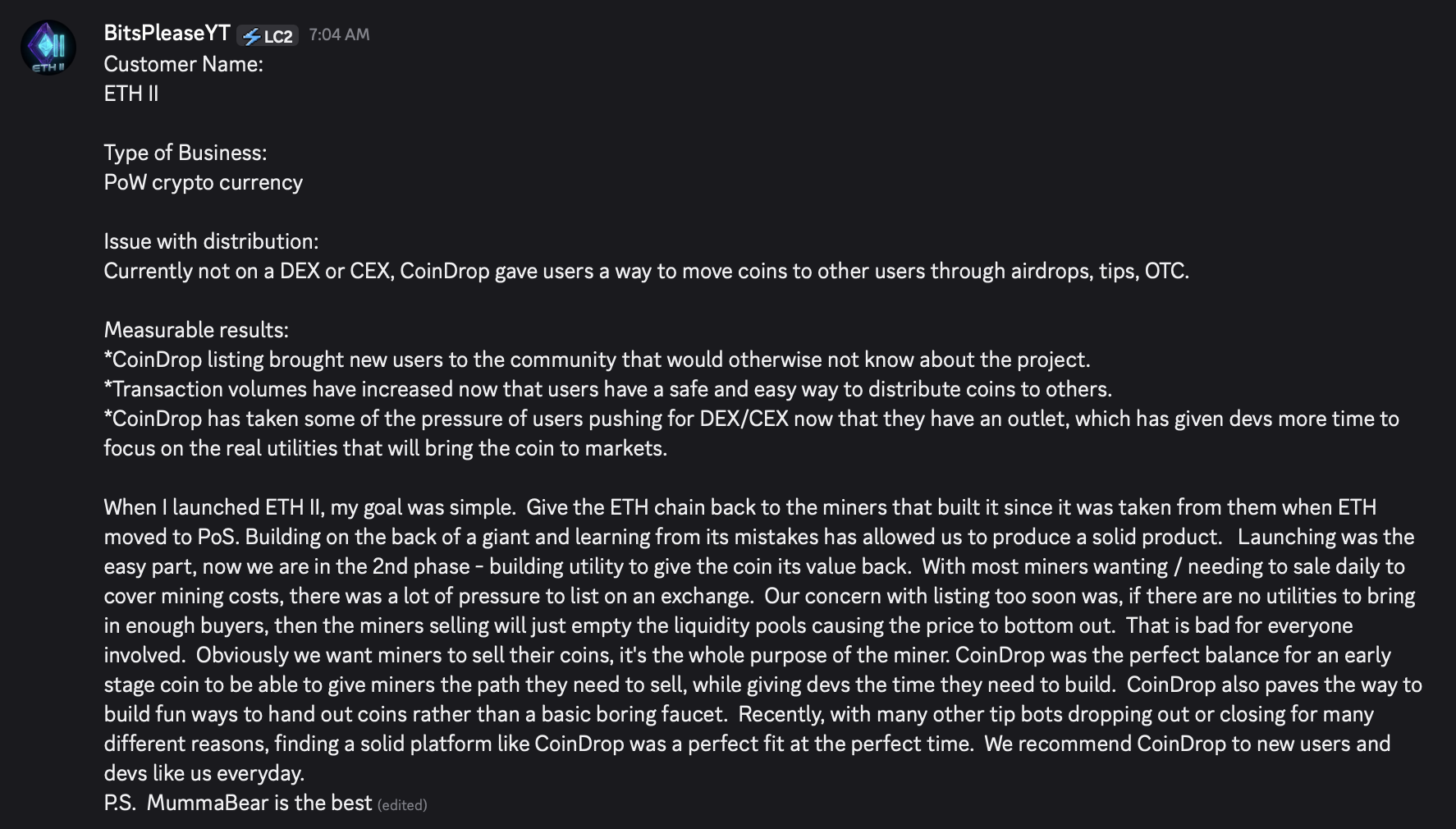
From ETH II's founder: CoinDrop brought new users to the community and took pressure off an early exchange listing.
Around the bot
- Web wallet. React 19, Vite and TanStack Query. Log in with Discord to send, deposit and withdraw, or pay a whole CSV of recipients in one go.
- Wallet API. Flask with Discord OAuth and cookie sessions, reading directly from the bot's ledger.
- Explorer. FastAPI. It shows transaction details from data the bot signs into each link, so it never calls an RPC.
- coindrop.cc. Next.js, with a page for every chain plus comparison pages and guides for search.
- Growth agents. They find Kick streamers and new token launches, qualify them, and draft personal outreach with Claude. Every draft waits in a private Discord channel until I approve it.
- Dropalot and AutoDrop. Companion bots that run random drop games in a server, paid from their own CoinDrop balance.